“Give the agent memory” sounds like a single feature. CS329Z’s seventh lecture turns it into a set of choices: what is remembered, when it is written or retrieved, and how it is stored. These choices affect task quality, cost, privacy, and the user’s control over the system.
Key insights #
- Memory has different jobs: preserve current context, recall episodes, retain facts, and reuse procedures.
- A memory architecture needs a write policy, retrieval policy, update policy, and deletion policy; a storage engine alone provides none of them.
- Tiered and reflective systems try to make long histories useful within a finite context window.
- Evaluate memory by whether it improves future tasks, not just whether a model can answer a fact-recall quiz.
- Forgetting, privacy, and poisoned memories are core design problems.
Four kinds of memory #
Drawing on CoALA, the lecture distinguishes working memory, episodic memory, semantic memory, and procedural memory. Working memory is the current context available to the model. Episodic memory is a record of experiences. Semantic memory stores facts or general knowledge distilled from them. Procedural memory stores skills or reusable methods.
This vocabulary prevents a common mistake: treating a vector database of chat logs as a complete memory system. Raw experience can be retrieved, but the agent may also need a concise fact, a reusable procedure, or a current commitment. The lecture further distinguishes parametric memory in model weights from context memory supplied at inference time. Updating a file or retrieval store is operationally different from retraining a model.
The motivation slides distinguish three losses without memory: procedure (the agent must relearn a method), knowledge (facts and preferences disappear), and progress (a later session cannot continue earlier work). The corresponding benefits are personalization, learning from experience, and statefulness. They call for different records and retrieval triggers.
The lecture asks three design questions before choosing a database: what to store and retrieve, when to do it, and how to represent and search it. Files offer a hierarchy and ordinary search commands. A database can combine semantic retrieval with metadata and exact-term lookup. Knowledge graphs make relationships explicit. The right choice follows the question the agent will later need to answer.
Four architecture patterns #
Source: CS329Z Lecture 7, PDF page 29.
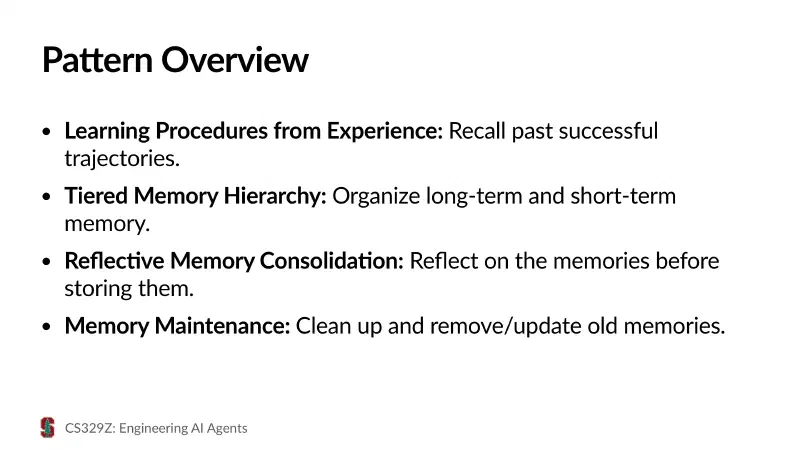
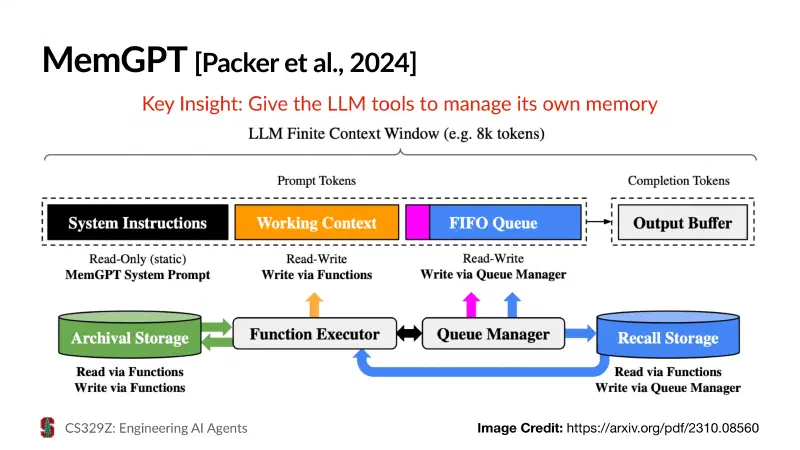
The slides organize existing systems into four patterns. Learning procedures from experience saves successful trajectories or skill files, as in Voyager and Agent Workflow Memory. Tiered memory keeps a small active context and moves information to and from larger stores. MemGPT treats this like virtual memory: the model gets operations to write, replace, and search outside the immediate context.
Source: CS329Z Lecture 7, PDF page 43; figure from the original paper.
Reflective consolidation turns many events into higher-level observations. Generative Agents records experiences, reflects on them, and retrieves relevant memories to plan later behavior. Maintenance periodically updates, merges, or removes records so the store does not become a graveyard of stale or contradictory facts. The lecture’s filesystem, database, and knowledge-graph examples are storage choices that can support these patterns; none determines the memory policy by itself.
The procedure-learning examples make the first pattern concrete. Voyager saves executable skills for later reuse. Agent Workflow Memory abstracts successful trajectories into workflows that can be included in future prompts. These stored procedures can become brittle when the environment changes, which is why a skill should be updateable and checked against current conditions.
In MemGPT, the agent gets operations to write or replace working context and search larger recall or archival stores. The OS analogy is about movement between memory tiers, not an unlimited effective context window. Generative Agents shows a different pattern: reflections distill many raw experiences into higher-level facts that can influence planning. Sleep-time compute, A-Mem, and Mem0 in the slides push maintenance further by reorganizing memory outside the immediate user turn.
Evaluate what the memory lets the agent do #
The lecture surveys LoCoMo, PersonaMem, LongMemEval-v2, and MemoryArena. They emphasize different capabilities: long conversations, evolving preferences, trajectory recall, and completion of tasks that build on earlier ones. The proposed benchmark criteria are memorable: realistic sources and queries, long enough histories, challenging tasks, and verifiable outcomes. A benchmark that only asks for an obvious fact from a short conversation cannot tell whether a memory architecture helps in a long-running agent.
The benchmarks illustrate an important progression. LoCoMo asks questions over long simulated conversations. PersonaMem tests evolving user preferences but often uses multiple-choice questions. LongMemEval-v2 draws on web-agent trajectories, moving closer to real agent experience. MemoryArena asks the system to complete tasks whose constraints accumulate over time. The lecture cautions that even retrieving the right memory does not guarantee the model will use it correctly.
The hardest part may be forgetting. At write time, future relevance is uncertain. Keeping everything raises retrieval and context costs; deleting a record may erase a promise or an important preference. The closing slides add trust, privacy, user control, and poisoned procedural memories to this problem. A memory system should expose what it stored and let users correct or remove it. It also needs to treat remembered instructions as data that may be wrong or adversarial.
The practical design lesson is to start with the future behavior memory should improve, then define write, retrieval, update, and deletion rules that can be evaluated against that behavior.
An over-eager model can also insert irrelevant remembered facts into a response. The final slides emphasize user control over personal data and the risk of poisoned procedural memories that instruct unsafe actions. A memory item should carry provenance and a way to correct or expire it; retrieval should not silently promote old content into authority.
Further reading #
- Lecture 7 slides and video with captions
- Sumers et al., Cognitive Architectures for Language Agents
- Packer et al., MemGPT
- Park et al., Generative Agents