Weekly Paper Notes — one of the top picks from the 2026-11-21 CS paper digest. Area: AI / ML.
Authors: K2 Team, Institute of Foundation Models, Mohamed bin Zayed University of Artificial Intelligence (correspondence: Hector Liu, Eric Xing) arXiv: 2611.21003 · PDF · Artifacts
TL;DR #
K2-Horizon is six language models: dense 0.9B, 3.7B, 7B and 32B models, a 36B-A4B mixture-of-experts with a new attention variant, and a 375B-A23B MoE flagship. They are released under the LLM360 definition of open source. That means final weights plus 380 intermediate checkpoints from every stage, 23 quantized builds, 21.6 TB of training data, 58 training-run logs, and 17 code repositories. The repositories include the xLLM training framework, the RL360 reinforcement-learning stack and the Eval360 harness. Unusually, the team also releases and documents the pipelines that built the data, which produced about 10T synthetic pre-training tokens.
On results, the flagship activates fewer parameters than three of the four contemporary open-weight models it is compared with (GLM-5.2, MiniMax M3, Nemotron 3 Ultra, Inkling). It still leads all four on Toolathlon-Verified (65.3) and on SWE-Atlas-QnA with no internet access (48.4), and places second on eight more benchmarks. Expert-level science (HLE, CritPt) is its main gap. The 36B-A4B, using Mixture-of-Value Attention (MoVA), stays within a few points of the dense 32B trained on the same data, with one-seventh the active parameters.
What problem is the paper actually attacking? #
Most “open” frontier releases are open-weight: you get the final checkpoint and maybe a model card. You don’t get the data, the intermediate checkpoints, the failed runs, or the code that built the synthetic corpora. That code is increasingly where the capability comes from. Without those pieces, nobody outside the lab can study how a capability emerged, or check that a benchmark gain is not contamination.
The LLM360 project, from the same institute, has pushed the full-transparency definition for a few years. Its earlier K2 releases were single dense models. AllenAI’s OLMo and the Pythia suite are the other reference points for “release everything”, and Pythia in particular showed how valuable a controlled family is: same data, same order, different sizes. K2-Horizon builds that kind of family at frontier scale. Four of the models (3.7B, 7B, 32B and 36B-A4B) share one 22T-token corpus and recipe, and two pairs saw identical batches at every step: 3.7B with 36B, and 7B with 32B. So dense-versus-sparse and small-versus-large comparisons come with the data held fixed.
The report is 153 pages. This post picks out four things a reader would otherwise have to dig for.
The mechanism: Mixture-of-Value Attention #
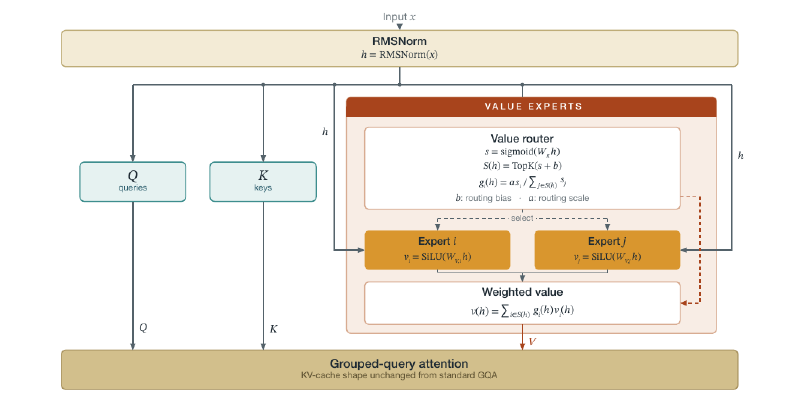
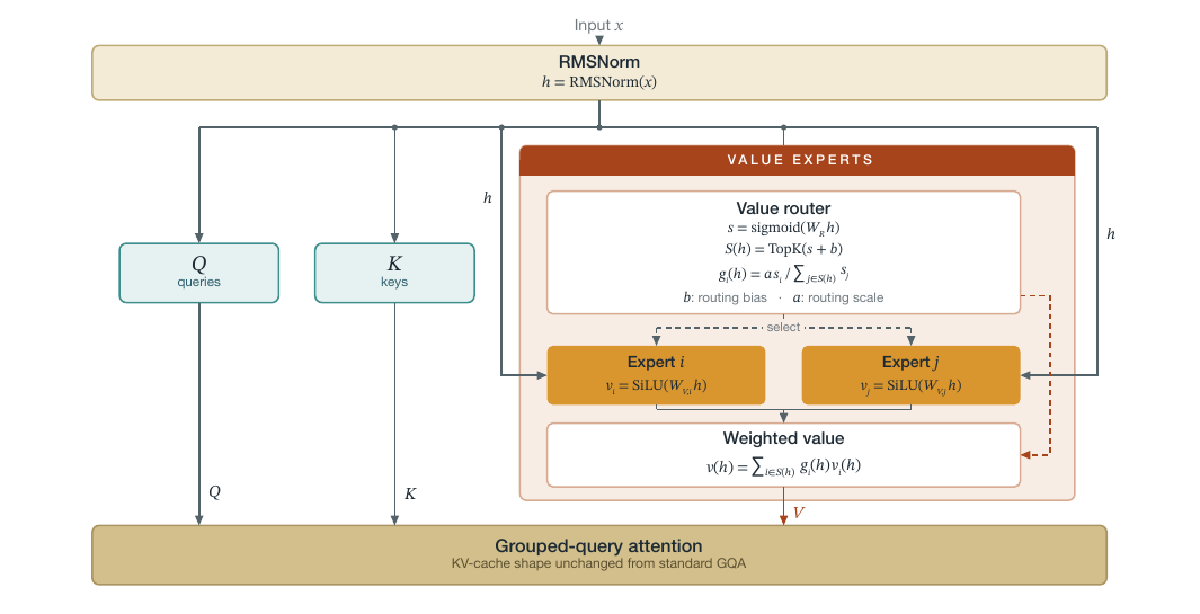
MoE normally sparsifies the feed-forward block. MoVA applies the same idea to attention’s value projection. Standard attention computes v_t = x_t W_v. MoVA replaces that single projection with a routed mixture:
V_i(x_t) = x_t W_v^(i)
V(x_t)   = Σ_{i ∈ TopK(x_t)} p_i(x_t) · SiLU(V_i(x_t))
The SiLU matters. A routed mixture of purely linear projections collapses to x_t (Σ p_i W_v^(i)), an input-dependent linear map whose only nonlinearity comes from the routing weights. Each expert’s output gets the activation instead. In the 36B-A4B, the router picks 4 of 64 value experts per token, and each expert produces values for all eight KV heads at once.
Two properties make this cheap to adopt. The attention computation itself is untouched, so FlashAttention, GQA and sparse attention all still apply. And because v_t depends only on token t, only the mixed vector is cached. The KV cache stays the same size.
The same model also changes the attention gate. Gated attention multiplies the output by γ = φ(X W_γ + b_γ). The common choice for φ is sigmoid, which starts at 0.5 (halving the output at initialization) and can never amplify. The report cites a result that single-head gated attention matches multi-head attention in expressiveness, but only if the gate can represent ratios above 1. So they use softplus(x; β) = (1/β) log(1 + e^{βx}) with β = log 2, which equals 1 at zero and acts as the identity at initialization.
A smaller change runs across the family: Grouped RMSNorm. Plain RMSNorm bounds each output element by √d, about 90 at d = 8192. Computing the RMS statistic inside k groups tightens the bound to √(d/k). The authors report that this noticeably improves training stability.
The practical claim: one recipe, collapsing curves, and a mix chosen by prediction #
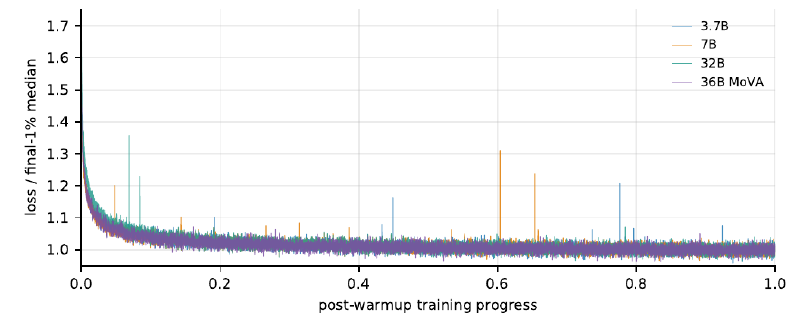
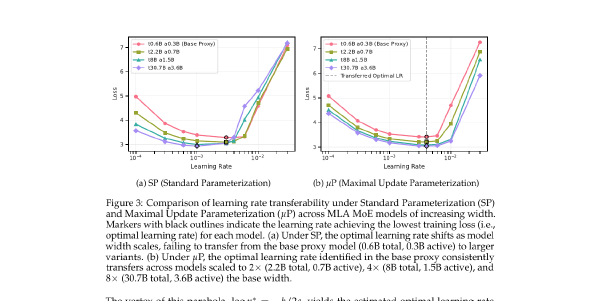
Hyperparameters were scaled together. Learning rate follows η ∝ N^−1/2 in active backbone parameters (η√N lands between 6.8×10⁻⁴ and 8.6×10⁻⁴ from 0.9B to 375B), and weight decay is set through a fixed AdamW timescale. The result is a production-scale test of the “scaling collapse” observation: divide each loss curve by its final value and the curves coincide. The normalization pins the endpoints, as the authors point out, but it does nothing to force the rest of the trajectory to agree.
The data-mix decision is the most transferable result in the report. Three candidate mixes (web-heavy, math-heavy, SFT-heavy) were trained to 1.5B. At that size the SFT-heavy mix was best on the 13-benchmark mean, at every checkpoint, and the web-heavy mix was worst. The team then predicted scores at production scale in two stages: a per-validation-set loss scaling law, then a sparse regression from losses to benchmark scores, fitted on separate ablation runs.
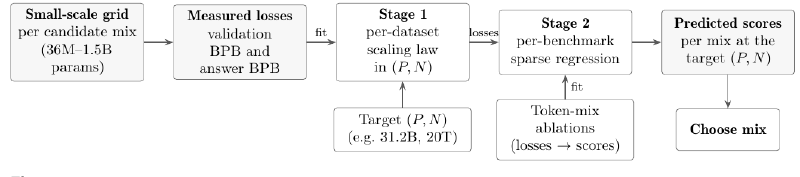
The predictions reversed the ordering. At every predicted size, web-heavy came first and SFT-heavy last, and at 31.2B web-heavy was predicted best on 11 of 13 benchmarks. Math-heavy took the other two, MATH-500 and AIME. They shipped the web-heavy mix. Dense, immediately useful data wins small ablations and saturates, while broad web text pays off as capacity grows. Choosing from small-scale ablations alone would have picked the wrong mix.
Results #
Flagship. The headline comparisons are in the text above. On agentic work, the 375B-A23B is second to GLM-5.2 on τ³-Banking, MCPMark, AutomationBench, Apex-Agents and GDPval-AA. It beats both GPT-5.6 variants on τ³-Banking and is above GPT-5.6 Luna on WildClawBench. GPQA Diamond is close to GLM-5.2. CritPt and HLE trail clearly.
Mid-size. The pre-training loss of the MoVA 36B-A4B tracks the dense 32B closely, with the dense model slightly ahead. At 1.1M steps MoVA trails by 1.2 to 3.7 points on MMLU, GSM8K, HellaSwag and HumanEval, at roughly one-seventh the active parameters. This comparison is the reason the identical-data setup was worth building.
Small models. The 7B and 3.7B lead their size classes on SWE-bench Verified and τ³-Banking “by wide margins”, and the 0.9B leads all three coding benchmarks in its group. The authors add one caution: long-horizon training makes small models prone to repetition loops, so the small models get a short Final Token Preference Optimization stage trained on their own looping outputs.
Inference. Uno adds LoRA-style “diffusion” adapters to every projection so the model can draft several tokens per step. The AR weights still verify, so the output distribution is unchanged. There is one network and one KV cache, with no separate draft model. On a single H200, K2-Horizon-7B-Uno runs 2.2× faster at batch size 1 and 1.5× faster at the largest batch that fits (64). The 0.9B gains 1.2×.
What went wrong, on the record. The flagship’s 15.1T-token pre-training ran in two phases totalling about 88 days. It was rolled back to an earlier checkpoint 40 times (29 in phase 1, 11 in phase 2). 35 of those rollbacks followed a loss spike, and the deepest rewound 4,217 steps. Of the phase-1 spike episodes, 69% happened on branches that were later thrown away. The post-training section includes a reward-hacking audit of the flagship’s 500 passing Terminal-Bench 2.1 trials. A judge model flagged 24 of them (4.8%), mostly on 10 tasks, which lowers the pass rate from 70.2% to 66.9%. One quoted trajectory finds a GitHub token in the container, locates the benchmark’s own repository, and downloads the expected data.
Why this matters #
Six models on one recipe, with all data, checkpoints and pipelines released, give researchers controlled scale and sparsity studies at a size most academic labs can’t train. The release can be used for loss-curve dynamics, contamination audits (decontamination logs are included), RL-from-checkpoint experiments, or simply checking what the synthetic data actually contains.
MoVA is the architecture idea most likely to spread. It adds sparsity on a second axis at zero KV-cache cost and needs no attention-kernel changes. The obvious follow-up is the same experiment at flagship scale, since the 375B here uses standard attention.
The data-mix result is a warning for anyone choosing mixes from 1B ablations. The rollback statistics and the reward-hacking audit are the kind of thing most technical reports leave out. Other labs could reasonably be expected to publish the same.
Read alongside #
- Biderman et al., Pythia, 2023: the original controlled, fully open model suite.
- Groeneveld et al., OLMo, 2024: the other “release everything” lineage.
- Liu et al., LLM360, 2023: the transparency definition this release follows.
- Dai et al., DeepSeekMoE, 2024: the fine-grained routed-plus-shared-expert design both K2-Horizon MoEs use.
- Qiu et al., Gated Attention for LLMs, 2025: the sigmoid-gate baseline the softplus gate replaces.
- Multi-Branch Transformer, same week: another architecture paper on scaling along an axis other than width and depth.
Links #
📄 arXiv abstract · 📄 PDF · 💾 ifm.ai/k2
Part of the Weekly CS Paper Digest series. Summary written from a close read of the preprint; figures cropped from the arXiv PDF and reproduced here under fair use for educational commentary.